

Founders Contract Guide: Essential Steps for 2025 Startups
Launching a startup in 2025 is thrilling, but skipping a founders contract can quickly turn excitement into chaos. Imagine pouring months into your idea, only to hit a wall because roles, equity, or ownership were never clear.
A founders contract is the foundation that protects your business, relationships, and future growth. This guide breaks down every step you need to create a contract that shields your startup from common pitfalls.
You’ll discover what a founders contract is, why it matters, how to create one, key clauses for 2025, best practices, and essential resources. Secure your vision, avoid disputes, and set your team up for lasting success.
Understanding the Founders Contract: Definition, Purpose, and Benefits
Launching a startup without a clear founders contract is like building a house on sand. Many entrepreneurs assume a handshake or verbal agreement is enough, but this leads to confusion and conflict down the road. So, what exactly is a founders contract, and why is it a must-have for 2025 startups?

What is a Founders Contract?
A founders contract is a legal document that outlines the roles, responsibilities, and expectations between co-founders of a startup. Unlike shareholder or operating agreements, a founders contract focuses specifically on the relationship and commitments among those building the company from day one. While not legally required, having this contract is highly recommended.
Key features include equity splits, decision-making processes, and intellectual property assignments. For example, a simple founders contract could have prevented the infamous split of a popular tech startup, where two friends disagreed on ownership and direction, leading to a costly legal battle. For more on essential elements, see Founders agreement essentials.
Why Every 2025 Startup Needs One
A founders contract brings clarity to your startup journey. It helps define each founder’s role, outlines responsibilities, and sets expectations for time commitment and contributions. This transparency reduces misunderstandings and future disputes.
Protecting intellectual property and company assets is another crucial reason for having a founders contract. Investors also view startups more favorably when they see these agreements in place. According to recent industry data, over 65% of startups face co-founder disputes within the first two years, highlighting the importance of a solid agreement early on.
Key Benefits for Modern Startups
Modern startups benefit from a founders contract in several ways:
- Safeguards against founder exits, resignations, or forced removals
- Ensures fair and transparent equity distribution with vesting schedules
- Provides a clear process for resolving disputes
- Boosts credibility with partners, investors, and accelerators
These benefits help startups avoid common pitfalls and build a strong foundation for sustainable growth. A founders contract is not just a formality, but a strategic tool for long-term success.
Common Misconceptions and Risks of Not Having a Contract
Some founders believe a handshake or verbal promise is enough, but this is a risky misconception. Without a founders contract, teams often face:
- Costly legal battles over equity and ownership
- Confusion about intellectual property rights and who owns what
- Disputes over capital contributions and future funding
Real-world examples abound, such as startups that lost their core technology or faced expensive lawsuits due to unclear agreements. Addressing these issues early with a founders contract can save your startup from major headaches and financial losses.
Step-by-Step Process to Creating a Founders Contract in 2025
Launching a startup is thrilling, but crafting a founders contract is where clarity and protection begin. The following steps break down what every founder should do to ensure your agreement is future-proof. Let’s walk through each critical stage together.

Step 1: Align on Vision, Values, and Commitment
Before drafting any founders contract, start with honest conversations. Sit down with your team and discuss long-term goals, the mission, and what success looks like for each person. Ask questions such as:
- Where do we see the company in five years?
- How much time can each founder realistically commit?
- What happens if someone wants to leave?
Misalignment in vision is a top reason startups split early. For example, two founders may disagree on whether to bootstrap or seek rapid venture funding. Taking time to align now can prevent major headaches later. If you want a deeper dive into how to structure these conversations, the Co-founders agreement guide provides a helpful framework.
Step 2: Define Roles, Responsibilities, and Decision-Making
Your founders contract should clearly outline what each founder is responsible for. Who handles product, sales, or operations? Document every role to avoid confusion as your team grows.
Set up decision-making processes. Will big decisions require a majority vote, or must everyone agree? Having clear voting rights and tie-breaker rules prevents deadlocks. Imagine a scenario where two co-founders disagree on pivoting the product. If the contract spells out how such disputes are resolved, you save time and relationships.
Step 3: Determine Equity Split and Vesting Schedules
Equity can be a sensitive topic, so your founders contract should lay out how shares are divided. Consider factors like:
- Initial contributions (money, skills, connections)
- Ongoing roles and responsibilities
- Willingness to take risks
Most startups use a standard vesting schedule, such as four years with a one-year cliff. This ensures founders earn their equity over time and prevents someone from leaving early with a large stake. Including these details can prevent founder disputes and protect the company’s future.
Step 4: Address Capital Contributions and Financial Arrangements
Financial clarity is vital. Your founders contract should specify how much initial capital each founder provides and how future funding needs will be met.
Discuss what happens if more money is needed. Will all founders contribute equally? What if someone cannot invest further? For example, if a founder cannot meet a capital call, the contract should outline options, such as reducing their equity or allowing other founders to cover the shortfall. Clear terms here prevent financial tension down the road.
Step 5: Protect Intellectual Property and Confidentiality
Founders often create valuable intellectual property (IP) early on. Your founders contract must state that all IP developed by founders belongs to the company.
Include confidentiality clauses covering code, trade secrets, and business plans. This ensures sensitive information stays protected, even if a founder leaves. For instance, a clear IP assignment prevents disputes over who owns product code or branding, which can otherwise stall or sink a startup.
Step 6: Plan for Founder Exits, Removals, and Resignations
No one likes to think about a founder leaving, but it’s essential to plan for it. Your founders contract should detail procedures for both voluntary and involuntary exits.
Include buyback rights and payout formulas for departing founders. For example, if a founder leaves, the company might have the right to repurchase their shares at fair market value. A well-written buy-sell clause can save your startup from operational deadlock and protect remaining founders from sudden disruptions.
Step 7: Include Dispute Resolution and Amendment Procedures
Conflicts happen, so your founders contract needs a plan for resolving them. Add mediation or arbitration clauses to handle disputes efficiently and privately.
Clearly state how amendments to the contract can be made. Will it require unanimous consent, or just a majority? This ensures your agreement can evolve as your startup grows and changes. By setting these processes now, you build a strong foundation for trust and flexibility within your team.
Essential Clauses and Provisions for 2025 Startups
A strong founders contract is built on clear, well-defined clauses. Each provision not only protects your business but also ensures founders stay aligned as your startup grows. Let’s break down the must-have clauses every 2025 startup needs. For a deeper dive, you can also review the Key clauses in a founders agreement for expert insights.
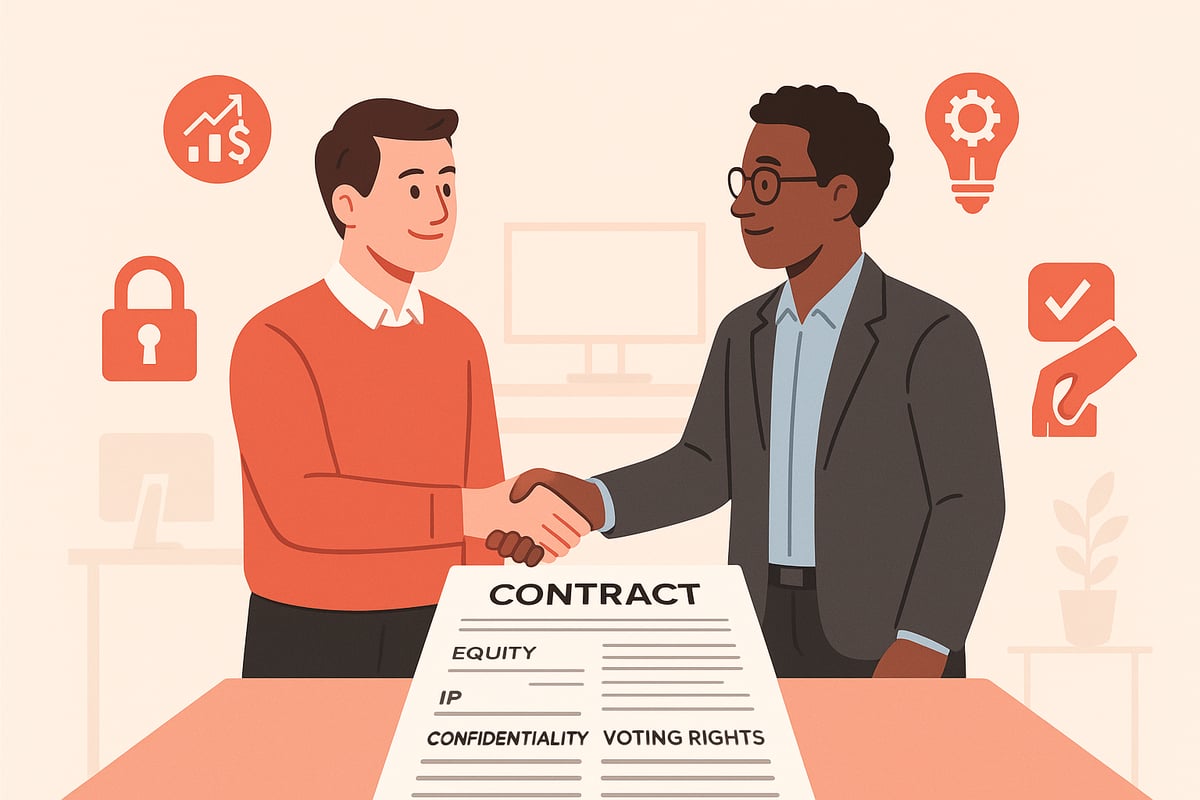
Equity and Ownership Structure
The foundation of any founders contract is the equity and ownership structure. This section spells out how much of the company each founder owns, and includes:
- Percentage of shares allocated to each founder
- Restrictions on transferring shares to outsiders
- Anti-dilution provisions to protect against future funding rounds
A sample clause might read:Each founder agrees not to transfer, sell, or assign shares without prior written consent of the majority.
Clear equity terms prevent misunderstandings and help keep everyone invested in the company’s future.
Vesting and Reverse Vesting
Vesting schedules are vital to ensure founders earn their equity over time. A typical founders contract uses a four-year vesting schedule with a one-year cliff. This means equity is gradually earned and protects the business if a founder leaves early.
Reverse vesting is equally important. It requires founders to return unvested shares if they depart before fully vesting, which discourages “free riders.”
Common triggers for accelerated vesting include company sale or founder removal without cause. Clawback provisions can reclaim shares from founders who leave under negative circumstances.
Intellectual Property Assignment
Assigning intellectual property (IP) is a non-negotiable part of any founders contract. All inventions, code, trademarks, and business plans created by founders must be assigned to the company.
Exceptions can be made for inventions unrelated to the startup’s business. For example, if a founder develops software on their own time for a different industry, it can be excluded.
Clear assignment language avoids disputes and ensures the startup owns its core assets as it grows.
Confidentiality and Non-Disclosure
Every founders contract should define what constitutes confidential information. This includes business plans, source code, client lists, and trade secrets.
Obligations typically last as long as the information remains confidential, often continuing after a founder leaves. Compliance with trade secret laws, like the Defend Trade Secrets Act, is essential.
A strong confidentiality clause protects your competitive edge and reassures partners and investors.
Decision-Making and Voting Rights
Decision-making provisions in a founders contract outline how big choices are made. These clauses should detail:
- What decisions require a majority vote versus unanimous agreement
- Tie-breaker mechanisms, such as a neutral third party or board vote
- Reserved matters that always need all founders’ approval
For example, raising new funding or changing the company’s mission might require a supermajority vote. Clear voting rights prevent deadlocks and ensure efficient governance.
Founder Exit, Removal, and Buyout Terms
Founder exits are inevitable, so your founders contract must address them. Key elements include:
- Triggers for removal, such as misconduct or failure to perform
- Procedures for voluntary resignation
- Buyout formulas based on fair market value or a pre-set formula
You should distinguish between “good leaver” scenarios (voluntary, positive departures) and “bad leaver” situations (misconduct, breach of contract). Each scenario should have clear payout terms to avoid disputes and keep the business on track.
Best Practices and Legal Tips for Drafting a Founders Contract
Creating a robust founders contract requires more than just filling out a template. It’s about building a document that truly reflects your startup’s unique DNA and protects everyone involved. Let’s break down the top best practices and legal tips for drafting a founders contract that stands the test of time and scales with your business.

Customization vs. Templates
While many startups are tempted to use online templates for their founders contract, one size rarely fits all. Templates can be a good starting point, but they often lack the nuance your business needs. Every startup has its own vision, equity structure, and risk profile.
Consider the pitfalls: a generic founders contract might miss crucial details about intellectual property or founder roles, leading to confusion later. For example, a startup that relied solely on a template faced costly legal battles when a departing founder claimed a larger equity share than intended.
Tailoring your agreement ensures it covers every scenario relevant to your team. For a deeper dive into what to include and why customization matters, check out Legal basics for startups.
Working with Legal Professionals
Consulting a legal professional can make all the difference when drafting your founders contract. While upfront legal fees may seem daunting, the investment pays off by preventing disputes and ensuring compliance with local laws.
A qualified startup lawyer helps clarify ambiguous terms, identify potential risks, and draft clauses that precisely reflect your intentions. They can also advise on jurisdiction, intellectual property, and dispute resolution mechanisms.
Legal review builds investor confidence and demonstrates your commitment to best practices. Many founders regret skipping this step after facing challenges that could have been avoided with professional guidance. Make legal advice a core part of your contract process.
Keeping the Contract Up-to-Date
A founders contract is not a static document. As your company grows, raises funds, or pivots, your agreement should evolve too. Schedule regular reviews, especially after major milestones like new investment rounds or onboarding new founders.
Amendments should always be documented in writing, signed by all parties, and stored securely. Real-world startups have faced operational headaches because their contracts didn’t reflect current ownership or responsibilities.
Set a calendar reminder to revisit your founders contract at least annually or after significant changes. This habit keeps your business aligned and helps prevent misunderstandings down the line.
Ensuring Enforceability and Compliance
For a founders contract to be legally binding, it must include all essential elements: clear terms, mutual consent, and lawful purpose. Avoid common pitfalls like vague language or missing signatures, which can render the agreement unenforceable.
Pay attention to jurisdiction and governing law clauses, as these determine how disputes are resolved. Regularly reviewing compliance with new regulations is crucial for startups in fast-changing industries.
For a thorough breakdown of what makes a contract enforceable, read this Legal guide for startup founders agreements. Taking these steps now can save you from costly litigation later.
Digital Signatures and Secure Storage
In 2025, digital signatures are widely recognized as legally valid for founders contract execution. They offer convenience, speed, and security, especially for remote teams.
Use reputable e-signature platforms that provide audit trails and encryption. Store signed contracts in secure, access-controlled digital vaults to ensure confidentiality and easy retrieval.
Regular backups and restricted access protect sensitive information from loss or unauthorized changes. Treat your founders contract as a living document, ensuring it’s both accessible and secure throughout your startup journey.
Resources, Tools, and Next Steps for Founders
Launching a successful startup in 2025 requires more than just a big idea. Having the right resources, tools, and next steps at your fingertips can make the difference between confusion and clarity. This section covers what you need to streamline your founders contract process and keep your business protected.
Sample Founders Contract Template Overview
A well-structured founders contract template gives your startup a strong foundation. Most templates follow a similar structure:
- Introduction and definitions
- Business purpose and goals
- Capital contributions and equity split
- Intellectual property assignment
- Roles, responsibilities, and decision-making
- Exit and dispute resolution terms
Each section should be tailored to your needs. For a deeper look at the most important provisions, check out this guide on essential provisions in a startup founder agreement. Reviewing a template with your team ensures everyone understands what is included and why it matters.
Recommended Legal Tools and Platforms
Digital tools make creating and managing your founders contract easier than ever. Here are some popular solutions:
| Tool/Platform | Features | Pros |
|---|---|---|
| Clerky | Startup-focused templates | Easy, legally sound |
| Docracy | Free contract database | Collaborative editing |
| DocuSign | Legally binding e-signatures | Secure, compliant |
| SeedLegals | Automated legal workflows | UK/EU focus, fast |
Choose a tool that fits your budget and legal needs. Always review any founders contract with a legal professional before signing.
Additional Key Startup Documents to Consider
A founders contract is just one piece of your company’s legal framework. You should also prepare other documents, such as:
- LLC operating agreement
- Buy-sell agreement
- Business plan
- Shareholder agreement
Each document serves a unique purpose and helps reduce risk. To understand more about the importance of equity splits and defining founder roles, see this article on equity splits and founder roles. Combining these documents with your founders contract gives investors and partners confidence in your business structure.
When and How to Update Your Founders Contract
Your founders contract should evolve as your startup grows. Update it when you:
- Bring in new founders
- Receive new funding
- Make a major business pivot
- Change equity arrangements
Follow this process:
- Identify what needs to change.
- Discuss proposed changes with all founders.
- Draft amendments in writing.
- Collect signatures using a secure platform.
- Store the updated contract safely.
Regular reviews mean your founders contract always matches your company’s reality.
FAQs: Common Founder Contract Questions
When should you sign a founders contract?
Ideally, before launching operations or raising funds.
What if a founder leaves early?
The founders contract should outline vesting and buyback terms for such cases.
Can you change the equity split later?
Yes, but all founders must agree and sign an updated contract.
Clear answers to these questions help prevent disputes and keep everyone aligned.
Where to Get Help and Advice
Drafting a founders contract can be complex, but you do not have to do it alone. Here are some trusted resources:
- Startup lawyers and legal clinics
- Mentorship programs and accelerators
- Online legal forums and startup communities
- Free guides from reputable organizations
Seeking expert input ensures your founders contract is legally sound and tailored to your business. Regularly consulting advisors and updating your resources keeps your startup on track.
If you're serious about building a strong foundation for your startup in 2025, connecting with other founders who have faced similar challenges can make all the difference. We’ve covered the key steps to creating a founders contract, but the real growth happens when you share experiences, learn from others’ stories, and tap into a supportive network. Ready to take your next step and surround yourself with like minded Swiss entrepreneurs who get it? Apply to our swiss founders community and start building relationships that will help your startup thrive.